
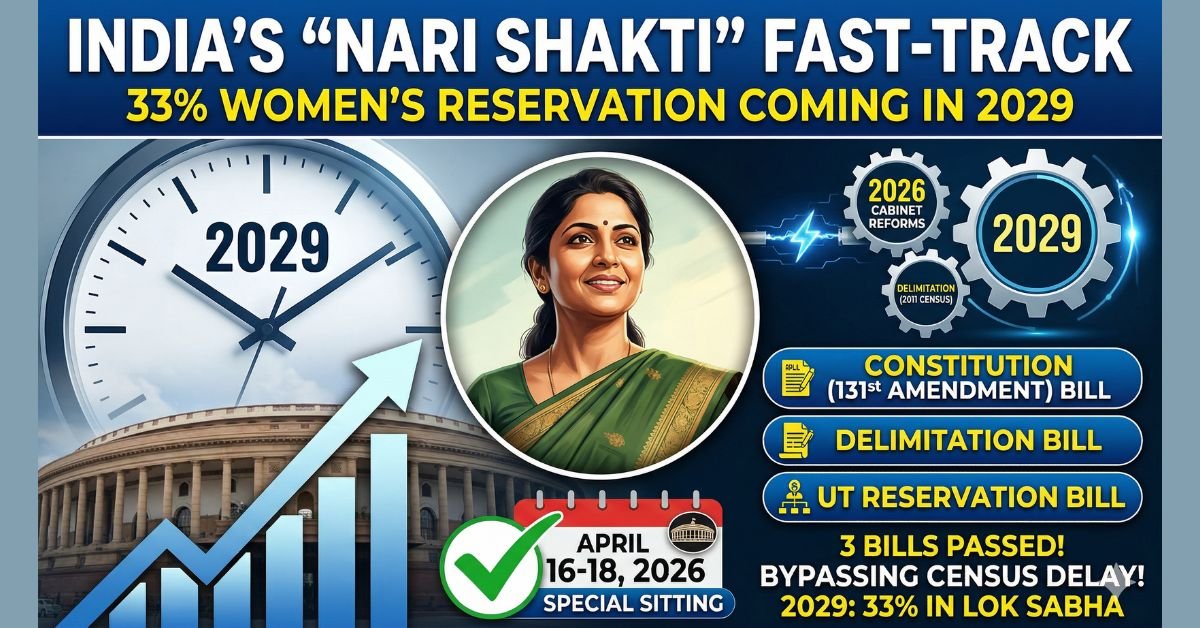
India’s "Nari Shakti" Fast-Track: 33% Women’s Reservation Coming in 2029
In a historic leap for gender equality, the Indian government has cleared the path for women to take up one-third of all seats in the Lok Sabha and State Assemblies by the 2029 General Elections. On April 8, 2026, the Union Cabinet, led by Prime Minister Narendra Modi, approved a series of amendments designed to break the "census deadlock" that threatened to delay this reform for another decade.
Why This Matters: Breaking the Census Deadlock
When the Nari Shakti Vandan Adhiniyam was first passed in 2023, it was tied to the completion of a new census and a subsequent delimitation (redrawing of boundaries). This meant women might have had to wait until 2034 to see the reservation in action.
The new 2026 Cabinet Reforms change the game. By using 2011 Census data, the government is fast-tracking the timeline, moving the rollout forward by a full five years.
The Legislative Roadmap (April 16–18, 2026)
To make this happen, a special three-day Parliament sitting has been convened from April 16 to 18, 2026. Three crucial bills will be introduced:
- The Constitution (131st Amendment) Bill: This tweaks the 2023 Act to remove the "new census" requirement.
- The Delimitation Bill: This authorizes the redrawing of constituencies based on the 2011 population figures.
- The UT Reservation Bill: A specific law to ensure women in Union Territories with assemblies (like Delhi and J&K) also get their 33% share.
A Bigger, More Inclusive Lok Sabha
To ensure that general competition remains fair while adding reserved seats, the Lok Sabha is set for its first major expansion in nearly 50 years.
This isn't just a win for women in general. The reservation follows a vertical quota system. This means that within the existing seats reserved for Scheduled Castes (SC) and Scheduled Tribes (ST), one-third of those seats will be specifically reserved for women from those same communities.
30 Years in the Making
From its first introduction in 1996 to the failed attempts of the late 90s and early 2000s, the journey of the Women’s Reservation Bill has been long and arduous. By delinking the law from the upcoming 2027 Census, the 2026 amendments ensure that the promise made in 2023 isn't just a distant dream, but a reality for the next generation of Indian leaders.
