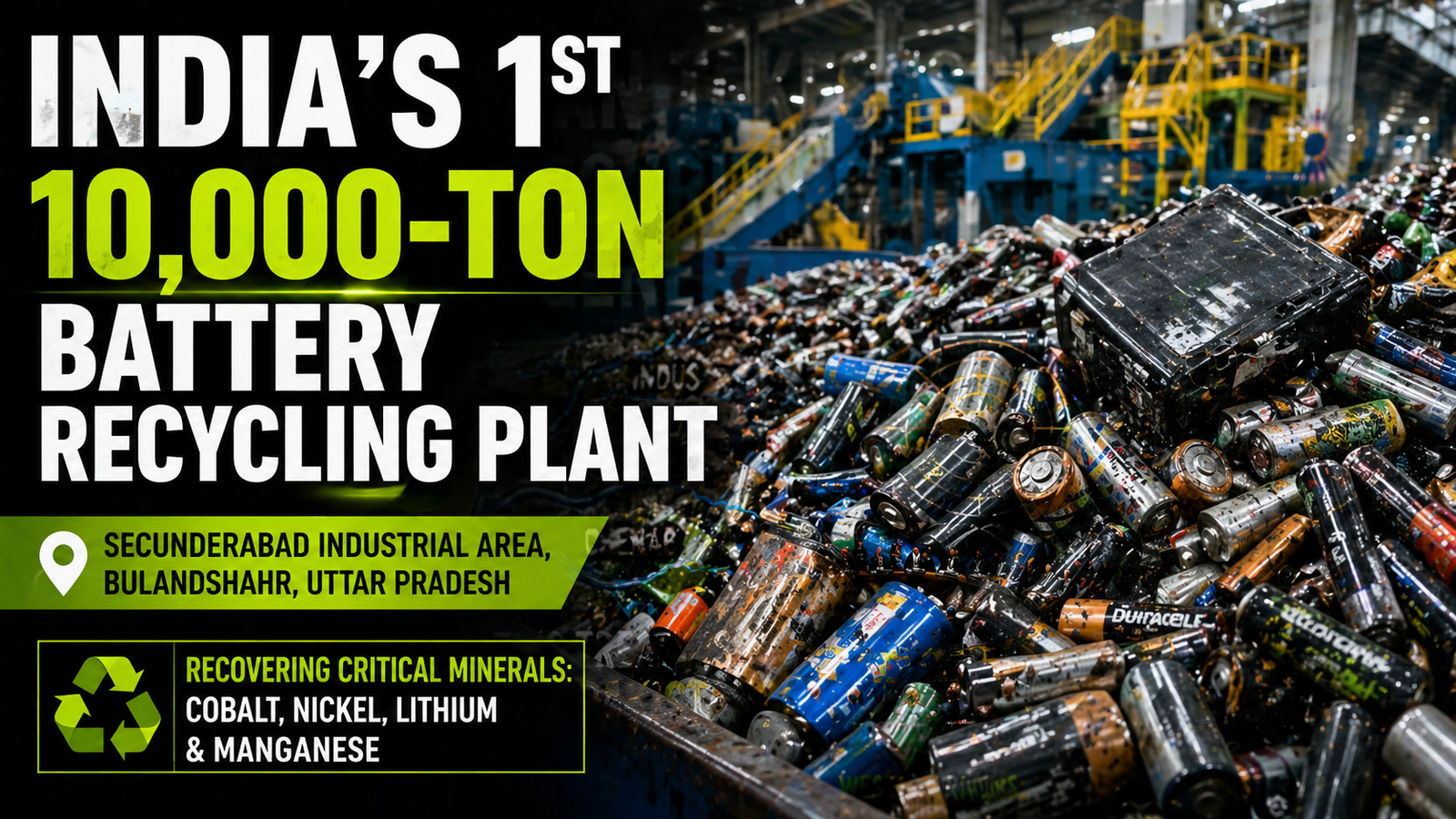
Rocklink India’s 10,000‑ton Recycling Plant in UP
Executive Summary: Rocklink India has opened a large recycling plant in Uttar Pradesh’s Sikandrabad Industrial Area (Bulandshahr district) to process electric vehicle batteries and rare-earth magnets. The plant can handle 10,000 tonnes per year of lithium-ion battery scrap and 60 tonnes per month of magnet waste, making it one of the biggest in India. It uses Rocklink’s in-house “R2” process to recover metals (cobalt, nickel, lithium, manganese, aluminium, copper, iron, etc.) at high rates (over 98% for Al/Cu/Fe) and will produce rare-earth chlorides (via a 22m rotary kiln) from magnet waste. The facility aims to close the loop on critical materials (batteries, EV motors) by circular supply chains. No official job or investment figures are given; regulatory compliance (EPR for batteries) and advanced pollution controls (VOC capture, gas treatment) are reported. Rocklink’s launch is seen as a strategic step for India’s EV and clean-energy industry, reducing import dependence for critical metals.
Facility Overview
Rocklink India Pvt. Ltd. (a subsidiary of Germany’s Rocklink Group) officially opened its Sikandrabad recycling plant on 23 April 2026. It is located in the UPSIDC Industrial Area, Sikandrabad, Bulandshahr district, Uttar Pradesh – about 60 km from Delhi. This is Rocklink India’s first such facility in India. It is designed to process three main streams:
- Lithium-ion batteries: Car, motorcycle, and other EV batteries (all chemistries and formats) will be shredded and treated.
- Rare-earth magnets: Permanent magnets (NdFeB, SmCo, AlNiCo from motors/speakers).
- Metal-rich industrial scrap: Includes battery casings, wiring, electronic waste, etc.
The plant has an initial capacity of 10,000 tonnes per year for LIB recycling. Magnet processing is 60 tonnes per month (≈720 t/yr), with a planned 1,500 t/yr rare-earth chloride line coming in 2026. (This matches company announcements.) The project is EPR-registered under India’s battery waste rules. Rocklink’s director Leonard Ansorge says the plant “aims to support a circular ecosystem for critical raw materials” used in EVs, renewables and advanced manufacturing
Technology and Process
Rocklink uses its proprietary “R2” recycling process (likely a mix of mechanical shredding, thermal and chemical steps) to recover materials. The plant can handle 95 different battery types (pre- and post-consumer scrap). In simple terms: batteries are first discharged and crushed; metals (Al, Cu, Fe, steel) are separated out (Rocklink reports >98% recovery of Al/Cu/Fe); and the remaining “black mass” (oxides of Li, Co, Ni, Mn) is sent for chemical refining. Rocklink claims this yields “high-purity black mass” for further processing. Bycatch hazardous gases (volatile organics) are captured via encapsulated handling and gas treatment systems, reducing emissions.
For magnets, semi-automated lines dismantle magnet assemblies into batches. Each batch is tested (“Know Your Material” lab) and either directly recycled or calcined in a 22-meter rotary kiln to produce rare-earth chlorides. These chlorides (oxides of Nd, Pr, Dy, Tb, etc.) can then be sent to smelters. Rocklink’s “MagCycle™” system (tested in Europe) will collect magnet scrap systematically for this line
Recovered Materials
Rocklink says the plant will recover key battery materials (Li, Co, Ni, Mn) and rare earth elements (lanthanides) from magnets. In Director Ansorge’s words, the inputs “translate into cobalt, nickel, lithium, manganese, as well as the rare earths… neodymium, dysprosium, and terbium”. In other words, nearly all valuable components of an EV powertrain can be reclaimed. Rocklink reports 98%+ yield for base metals (Al, Cu, Fe). The rest (black mass) will be refined to battery chemicals. For magnets, processing yields mixed rare-earth chlorides; Ansorge noted recycling could supply several percent of India’s NdFeB magnet demand. (Exact recovery rates for Li/Co etc. were not published.)
Environmental and Regulatory Aspects
Being a modern plant, Rocklink’s facility includes pollution controls. Volatile organic compounds from battery shredding are captured, and exhaust gases are treated. The kiln for magnet waste is “direct-heated” for safe calcination. The plant is officially EPR-registered under India’s Battery Waste Management Rules, meaning recyclers must meet standards for handling hazardous waste.
India’s new waste rules (2022, with 2025 amendments) actually mandate high recovery: 70% material recovery by 2024-25, rising to 90% by 2026-27. However, implementation has lagged – only ~1% of used LIBs are formally recycled today. Rocklink’s plant is a major step toward those goals. (Any formal approvals from environmental regulators were not detailed in announcements.)
Economic and Strategic Significance
For India’s economy and tech ambitions, this plant is significant. India imports most battery metals and magnets today. Local recycling can reclaim domestic scrap and avoid some imports. Government studies note India discards ~70,000 tonnes of LIBs yearly, and effective recycling could meet ~14% of battery material demand by 2030. Rocklink’s project will also support jobs (not specified) and signals growth of an EV supply chain. Director Ansorge said the plant is “built for future volumes” and they plan expansion (including a future dry-processing line and a second site).
Rocklink is also collaborating with startups, universities and agencies to improve India’s capabilities. In an industry context, this facility follows battery waste rules and ‘Make-in-India’ goals. East Asia Forum analysis notes that strong recycling frameworks are key to reducing dependency on imports (especially from China)
Industry experts welcome the move but note challenges. Leonard Ansorge (Rocklink) stressed that recycling alone won’t meet demand – it may cover a few percent of magnet needs. Battery specialist Mahesh Ganguly (IIT Bombay) has pointed out that India’s current EPR system is weak, with most e-waste going to informal sectors. He argues stricter tracking and compliance are needed for plants like Rocklink’s to reach their potential.
Nonetheless, observers see Rocklink’s launch as positive. It aligns with government targets (90% recovery by 2026) and represents industry building needed infrastructure. If expanded, such recycling facilities could help reduce import bills on lithium, cobalt and rare earths, and support India’s EV push