
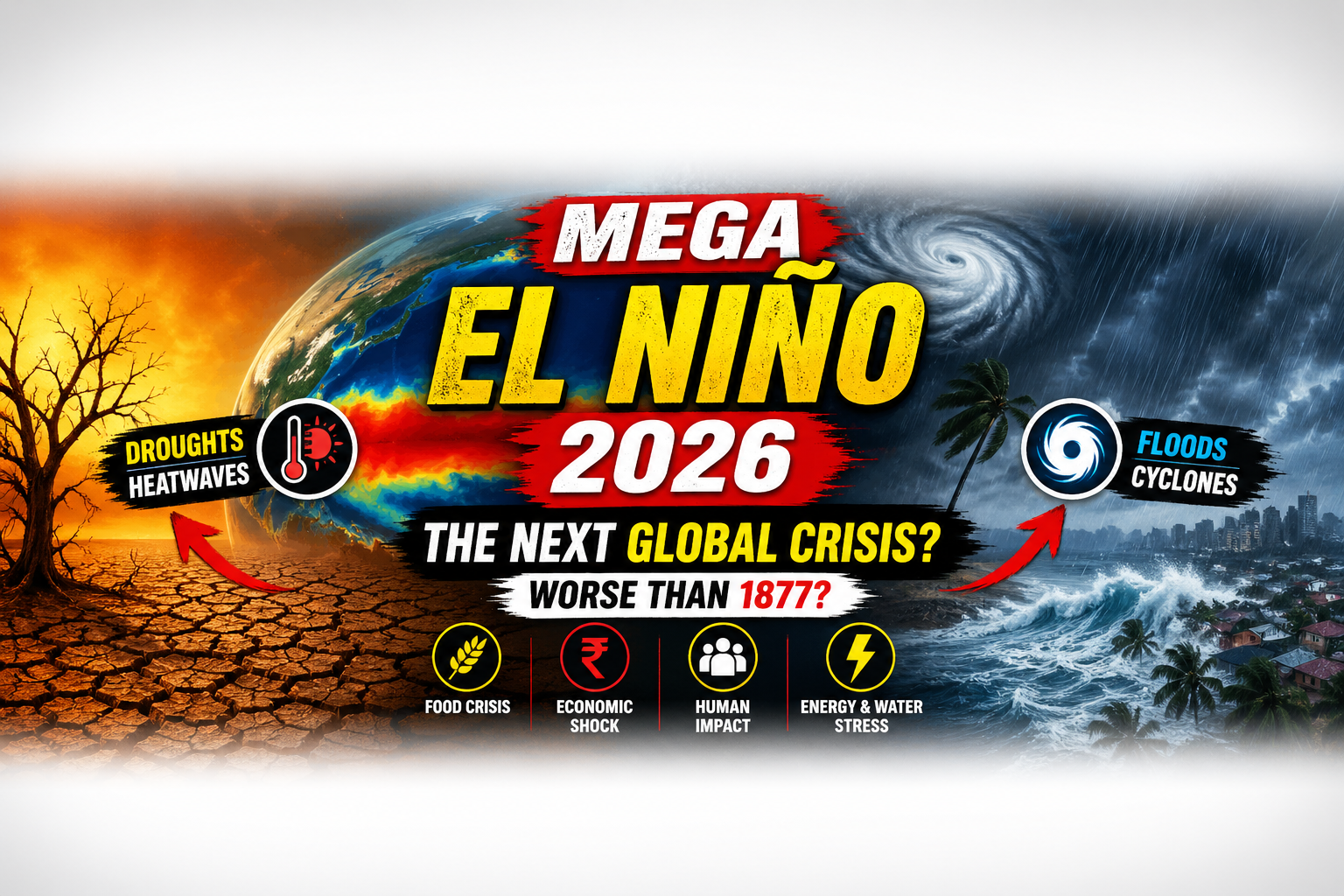
Mega El Niño 2026: Why Scientists Are Concerned About a Global Climate Crisis
The year 2026 is raising serious concerns among climate scientists due to the possibility of a “Mega” or “Super” El Niño event. While El Niño is a natural climate cycle, current conditions suggest it could become unusually intense due to global warming and rising ocean temperatures.
According to the data in your PDF , scientists are comparing this potential event to the 1877–78 El Niño, one of the deadliest climate disasters in history. But is the world ready this time? Let’s understand everything in simple language.
What is El Niño? (Simple Explanation)
El Niño is part of the ENSO system (El Niño–Southern Oscillation), a climate pattern in the Pacific Ocean.
Normal Conditions:
- Trade winds blow from east to west
- Warm water stays near Indonesia/Australia
- Cold water rises near South America
- India gets strong monsoon rainfall
During El Niño:
- Trade winds weaken or reverse
- Warm water shifts toward central/eastern Pacific
- Rainfall patterns change globally
- Monsoons weaken
What is a “Mega” or “Super” El Niño?
A Mega El Niño is an extreme version of the event.
Key Features:
- Sea Surface Temperature rises above +2°C
- Causes major global climate disruption
- Impacts can last 1–2 years
Famous Mega El Niño Events:
- 1877–78 (deadliest)
- 1982–83
- 1997–98
- 2015–16
Why 2026 is Alarming
According to the PDF (page 7), several warning signs are already visible:
1. Marine Heatwaves
- Pacific Ocean is unusually warm
- Acts as fuel for El Niño
2. Weakening Trade Winds
- Early atmospheric changes detected
- Can trigger El Niño formation
3. Climate Change Impact
- Oceans are already ~1°C warmer than pre-industrial levels
- El Niño now starts from a higher temperature base
This means future El Niño events can become stronger and more dangerous.
Expected Global Impacts (2026–27 Scenario)
Temperature
- Record-breaking global heat
- Higher chance of crossing climate thresholds
Drought Regions
- India
- Southeast Asia
- Australia
- Southern Africa
Flood-Prone Areas
- Western Americas
- Parts of East Africa
Extreme Events
- Stronger cyclones
- Increased wildfires due to dryness
?? India-Specific Impacts
1. Weak Monsoon
- El Niño is strongly linked to low rainfall years
- Not always certain, but highly correlated
2. Heatwaves
- Longer summers
- Dangerous “wet-bulb temperatures”
3. Agriculture
- Rain-fed farming suffers most
- Crops at risk:
- Rice (Kharif)
- Pulses
- Oilseeds
4. Economy
- Food inflation rises
- Rural distress increases
- Pressure on subsidies
5. Energy & Water Stress
- More electricity demand (cooling)
- Lower hydroelectric output
Lessons from the 1877–78 El Niño
The 1877–78 El Niño is remembered as one of the most devastating climate events in human history. It caused severe, multi-year droughts across many parts of the world, along with extreme global heat and a major failure of monsoon systems. These conditions led to a massive humanitarian disaster, with an estimated 30 to 60 million deaths, which was nearly 3–4% of the world’s population at that time. The worst-affected regions included British India, where the Great Famine occurred, China, which faced a northern famine, and parts of Brazil and Africa, where drought and starvation became widespread. Importantly, the scale of this tragedy was not just due to climate factors. It was made worse by human systems—especially colonial policies that prioritized food exports over local needs, and the lack of proper transport and relief systems.
Why Modern El Niño Could Be Worse (Despite Better Technology)
Today, the world is better prepared in many ways. We have advanced forecasting systems such as IMD and NOAA models, better food storage systems, global trade networks, and structured disaster management frameworks. Because of these improvements, the risk of large-scale deaths is significantly lower compared to the past. However, new challenges have emerged. The global population has now crossed 8 billion, cities are experiencing urban heat island effects, and climate change is intensifying weather extremes. This creates what scientists call a “compound risk,” where El Niño combines with global warming and population pressure, making its overall impact potentially more severe
Why El Niño Affects the Entire World
El Niño is not just about warming ocean waters—it actually reorganizes the entire global climate system. Through a process known as teleconnection, changes in the Pacific Ocean influence weather patterns across the globe. For example, countries like India and Australia may experience drought, while Peru and Ecuador often face heavy floods. In the United States, weather patterns can become uneven, with wet conditions in some regions and dry conditions in others. Meanwhile, Africa often sees mixed and unpredictable impacts. This global influence is why El Niño is considered a major climate driver
What is Happening Right Now (2026 Situation)
In 2026, scientists are already observing extreme heat conditions worldwide, along with a rapidly warming Pacific Ocean. These factors are creating favorable conditions for the development of a “Super” or “Mega” El Niño. Experts are increasingly concerned that this event could reach levels comparable to the deadly 1877–78 El Niño. The key concern is that a natural climate cycle like El Niño is now being amplified by human-driven climate change, making its impacts stronger and more dangerous than before
