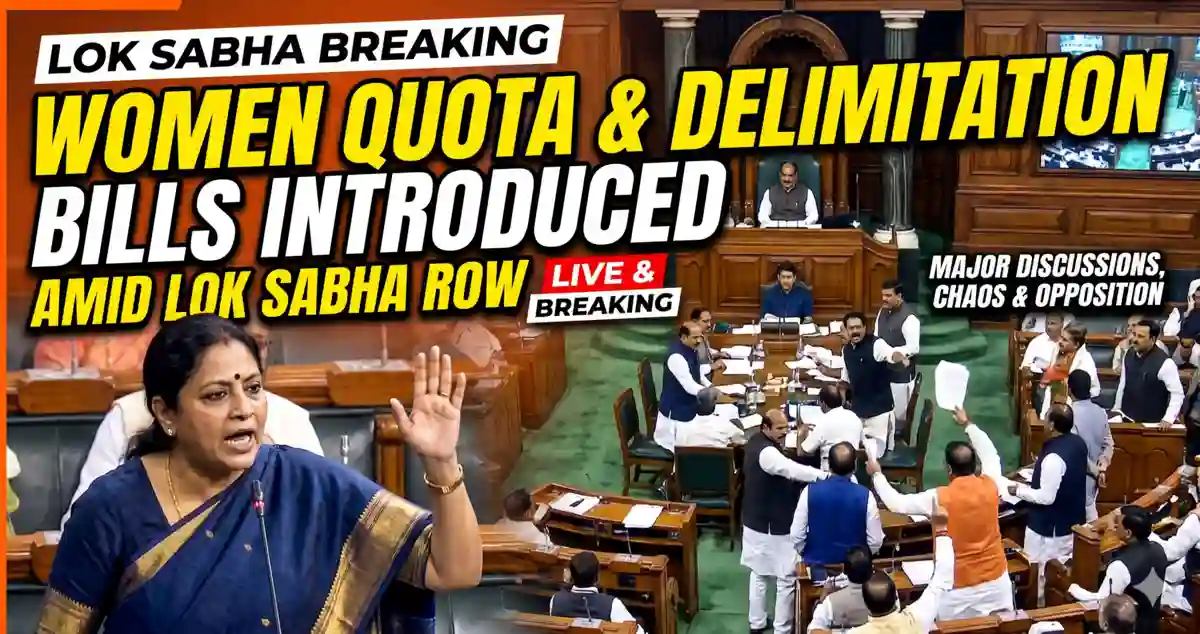
India’s Parliament (संसद) witnessed a major political development during the special session held from 16–18 April 2026, where the government introduced key constitutional and legislative reforms. These include the Women’s Reservation Bill implementation framework and the Delimitation Bill, 2026, which together aim to reshape India’s electoral system (चुनावी व्यवस्था).
What Happened in Lok Sabha? (लोकसभा में क्या हुआ?)
During the special session, three important bills were introduced:
- Constitution (131st Amendment) Bill, 2026
- Delimitation Bill, 2026
- Union Territories Laws (Amendment) Bill, 2026
These bills are meant to operationalise (लागू करना) the already passed Women’s Reservation Law of 2023.
Women’s Reservation (महिला आरक्षण) – Key Features
- 33% seats reserved for women in Lok Sabha and State Assemblies
- Includes reservation for SC/ST women (अनुसूचित जाति/जनजाति महिलाएं)
- Expected to be implemented from 2029 general elections
- Aims to increase women’s participation in politics (राजनीति में भागीदारी)
Currently, women hold less than 15% seats in Lok Sabha, highlighting the need for reform.
? In simple terms:
This bill ensures that every 3rd MP could be a woman (हर तीसरी सीट महिला के लिए) in future.
What is Delimitation? (परिसीमन क्या होता है?)
Delimitation (परिसीमन) means redrawing boundaries of constituencies based on population changes.
Key Points:
- Done after census (जनगणना)
- Ensures equal representation (समान प्रतिनिधित्व)
- New bill may increase total Lok Sabha seats significantly
- Likely based on latest available census data
? Example:
If population increases in a state, it may get more MPs (अधिक सांसद).
Why Are These Bills Linked? (दोनों को साथ क्यों लाया गया?)
The government has linked Women’s Reservation with Delimitation because:
- Reservation will be applied after new constituencies are created
- Helps avoid reducing seats of existing MPs
- Ensures fair distribution of reserved seats
In simple words:
? First redraw seats (परिसीमन), then apply reservation (आरक्षण लागू करना).
Why is There a Row? (विवाद क्यों हो रहा है?)
The bills have triggered strong political debate (राजनीतिक विवाद):
1. Opposition Concerns
- Fear of power imbalance (शक्ति असंतुलन) between states
- Southern states worry about losing influence
- Allegations of political advantage through seat redistribution
2. Demand for Immediate Reservation
Some leaders argue:
- Women’s quota should be implemented without waiting for delimitation
- Should apply to current 543 seats
3. Population-Based Representation Issue
- States with higher population may get more seats
- States controlling population growth may feel “punished”
Government’s Stand (सरकार का पक्ष)
The government has defended the move by stating:
- It is a historic reform (ऐतिहासिक सुधार)
- Will ensure inclusive democracy (समावेशी लोकतंत्र)
- Women’s representation will strengthen governance (शासन)
Prime Minister emphasized that this is a long-pending demand (लंबे समय से लंबित मांग).
Conclusion (निष्कर्ष)
The introduction of the Women’s Reservation and Delimitation Bills in Lok Sabha (लोकसभा) marks a major turning point in India’s democracy. While the aim is to empower women (महिला सशक्तिकरण), the linkage with delimitation has created significant political debate (गंभीर विवाद).
The final outcome will depend on Parliament approval, state ratification (राज्य अनुमोदन), and how fairly the delimitation process is carried out.
? In short:
This reform has the potential to change India’s political structure (राजनीतिक ढांचा बदलना)—but only if implemented carefully and fairly.