Pakistan Raises Indus Waters Treaty Issue at United Nations: Explained in Simple Terms
What is the Latest Issue?
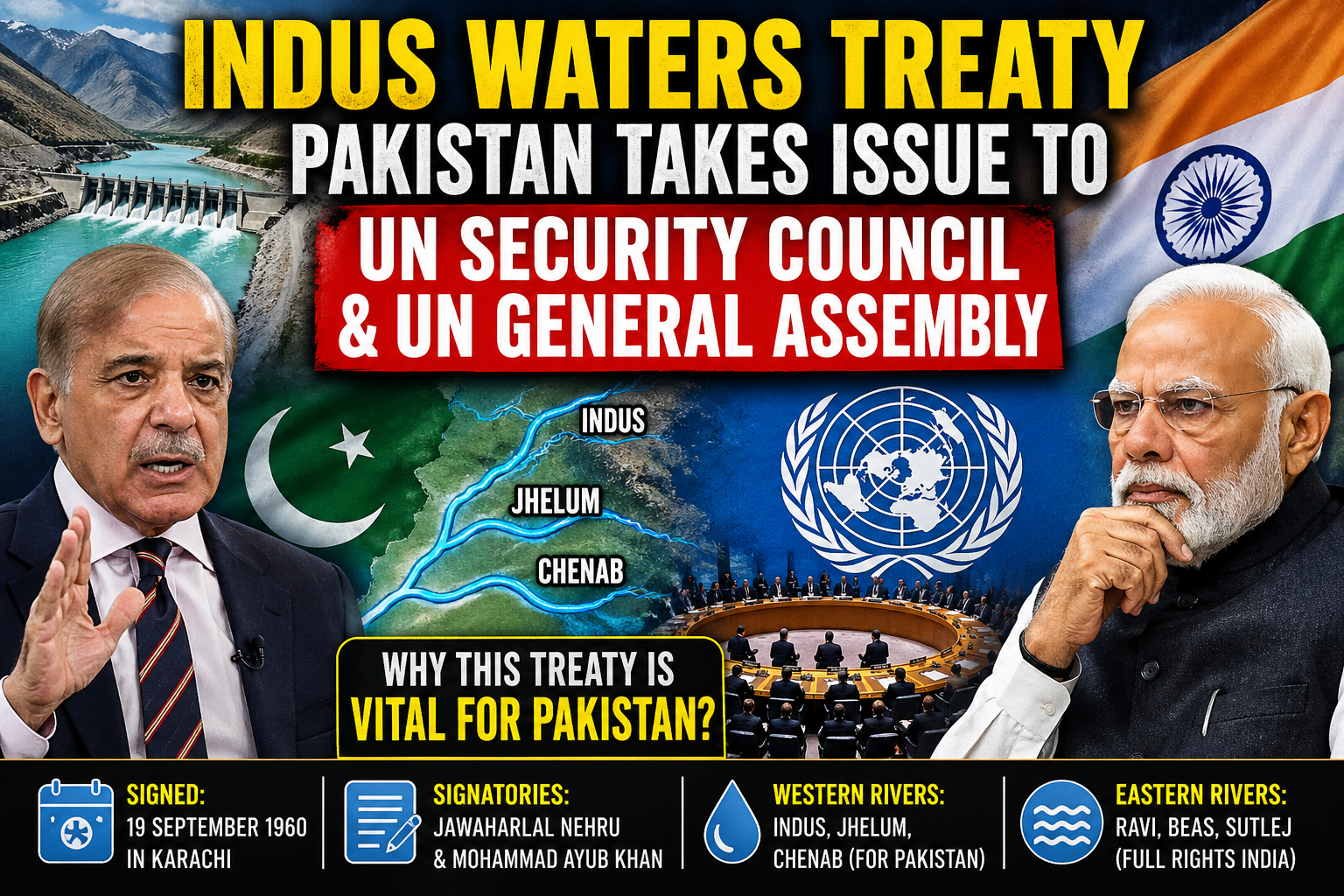
Pakistan has recently taken the matter of the Indus Waters Treaty (IWT) to international platforms like the United Nations Security Council and the United Nations General Assembly.
Pakistan has urged for the “full implementation” of the treaty and expressed concern over India’s decision related to the agreement, calling it a “grave threat to regional peace and security.”
This development has again brought global attention to one of the most important water-sharing agreements in the world.
What is the Indus Waters Treaty?
The Indus Waters Treaty (IWT) is a historic agreement between India and Pakistan that manages how river water is shared between the two countries.
- Signed on: 19 September 1960
- Location: Karachi
- Key Leaders:Jawaharlal Nehru
- Mohammad Ayub Khan
This treaty is considered a landmark agreement because it has survived wars and tensions between both nations.
How the Water is Divided
The treaty divides six rivers of the Indus basin into two groups:
1. Eastern Rivers (Given to India)
- Ravi
- Beas
- Sutlej
India has full rights over these rivers.
2. Western Rivers (Mainly for Pakistan)
- Indus
- Jhelum
- Chenab
Pakistan gets major rights, while India is allowed limited use (like hydroelectric projects without altering flow significantly).
Why is the Treaty So Important for Pakistan?
The Indus Waters Treaty is extremely critical for Pakistan’s survival and economy:
- Agriculture Dependence:
- Pakistan relies heavily on the Indus, Jhelum, and Chenab rivers for irrigation. A large portion of its farming depends on this water.
- Water Security:
- These rivers are the main source of freshwater for millions of people.
- Energy Needs:
- Hydropower projects in Pakistan also depend on these rivers.
Because of this dependence, any change in water flow or treaty implementation becomes a major concern for Pakistan.
Why is the Issue at the UN Important?
By raising the matter at international forums like the UNSC and UNGA, Pakistan is:
- Trying to internationalize the dispute
- Seeking global attention and support
- Emphasizing that water issues can impact regional peace and stability
However, traditionally, India maintains that the Indus Waters Treaty is a bilateral agreement and should be resolved directly between the two countries.
Why the Treaty is Unique
The Indus Waters Treaty is often praised globally because:
- It has survived multiple wars between India and Pakistan
- It is one of the most successful water-sharing agreements in the world
- It includes a detailed dispute resolution mechanism
The Indus Waters Treaty remains a crucial pillar of India-Pakistan relations. Pakistan’s move to raise the issue at the United Nations highlights the growing sensitivity around water resources in the region.
Even after decades, this treaty continues to play a vital role in maintaining balance, cooperation, and stability between the two neighboring countries.