
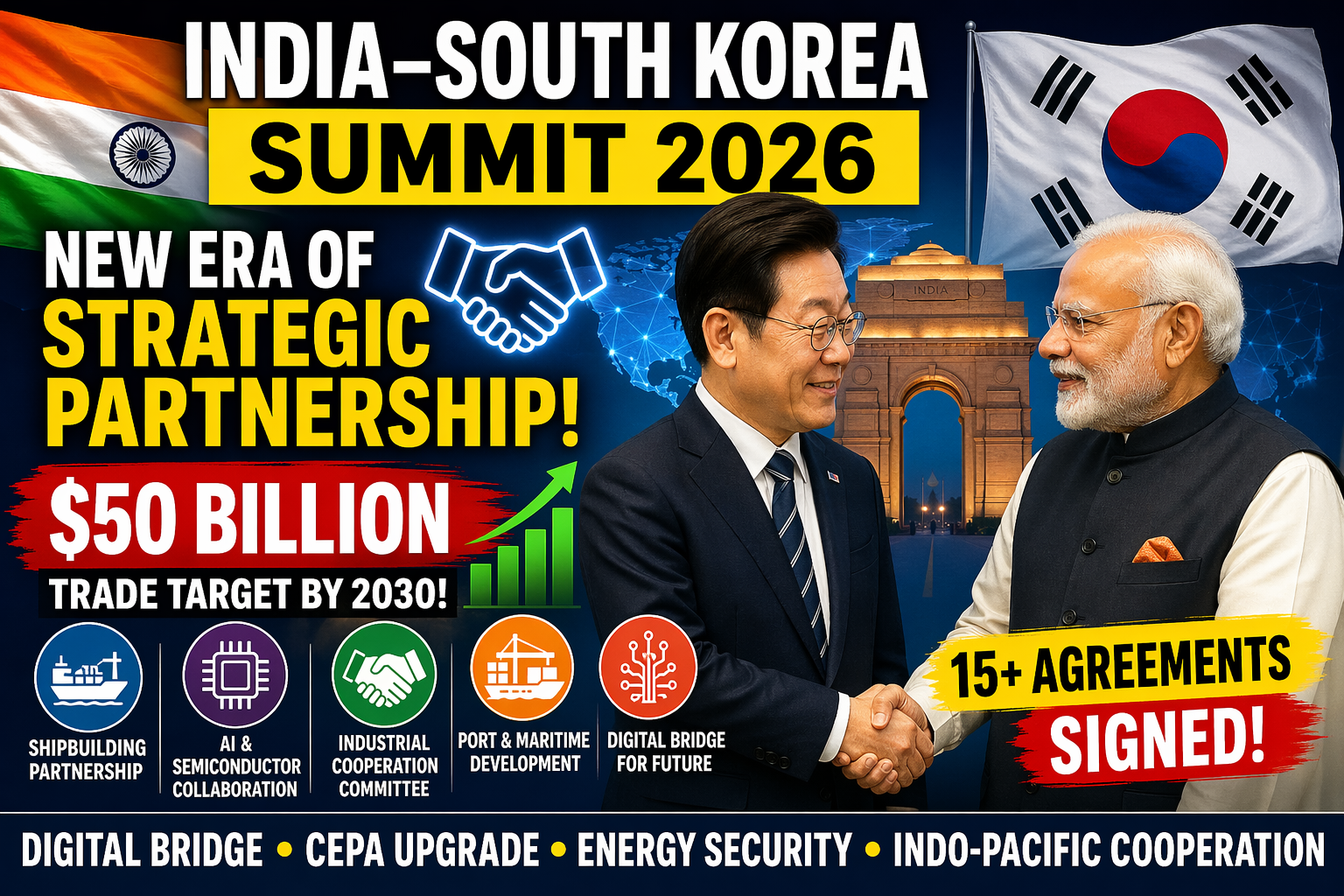
India and South Korea significantly strengthened their bilateral relations during a landmark summit held in New Delhi on 20 April 2026, when South Korean President visited Prime Minister Narendra Modi. This summit marked a major upgrade in their Special Strategic Partnership, focusing on trade expansion, advanced technology cooperation, and global strategic alignment.
Both countries agreed to double their bilateral trade to $50 billion by 2030, from the current level of around $27 billion. Along with this, they decided to revive and upgrade the Comprehensive Economic Partnership Agreement (CEPA) and launch new cooperation mechanisms in sectors like industry, technology, and security.
Major outcomes of the summit included the launch of a Joint Strategic Vision (2026–2030), establishment of an Economic Security Dialogue, and formation of a new Industrial Cooperation Committee. Several agreements and MOUs were signed across sectors like shipbuilding, ports, SMEs, steel, and digital technology.
The leaders emphasized combining India’s strength in AI and software with Korea’s expertise in semiconductors and manufacturing, calling it a “tremendous synergy.” Prime Minister Modi highlighted the future scope of cooperation “from chips to ships, from talent to technology, and from environment to energy.”
Points to Remember
- Summit Date: 20 April 2026
- Trade Target: $50 Billion by 2030
- Agreement: CEPA Upgrade Planned
- Key Initiatives: Digital Bridge, Economic Security Dialogue
- Focus: AI, Semiconductors, Shipbuilding, Energy
Historical Background & Strategic Context
The 2026 summit builds upon earlier progress made in 2018, when South Korean President Moon Jae-in visited India. That visit resulted in a Joint Vision based on “People, Prosperity, and Peace”, along with multiple agreements in trade, infrastructure, and science & technology.
An early proposal to upgrade CEPA and a Future Strategic Group for technologies like AI and IoT were also introduced in 2018. The 2026 summit not only reaffirmed those commitments but expanded them significantly by focusing on emerging sectors like semiconductors, digital infrastructure, and clean energy.
Strategically, both India and South Korea share a common vision of a rules-based Indo-Pacific region. The partnership is now evolving into a futuristic collaboration aimed at reducing supply chain risks and addressing regional challenges through deeper cooperation.
Points to Remember
- 2018 Visit: Moon Jae-in to India
- Vision: People, Prosperity, Peace
- 2026 Focus: Future tech + supply chain security
- Region: Indo-Pacific strategic alignment
Timeline of the Visit (April 2026)
The summit was conducted over three days with multiple high-level engagements and business interactions.
- 19 April 2026: Arrival in New Delhi, ceremonial welcome, visit to industrial sites like Samsung factory
- 20 April 2026: Main summit at Hyderabad House, Joint Vision announced, multiple MOUs signed, Business Forum आयोजित
- 21 April 2026: Final meetings and departure
During the summit day, around 200 Korean CEOs participated in the India–Korea Business Forum, where over 20 private-sector agreements were signed.
Points to Remember
- Duration: 19–21 April 2026
- Key Day: 20 April (Summit Day)
- Business Participation: ~200 CEOs
- Private MOUs: 20+ agreements
Key Joint Statements & Announcements
Several important joint statements were released during the summit, highlighting the future roadmap of cooperation.
The Joint Strategic Vision (2026–2030) emphasized expanding political dialogue, strengthening economic cooperation, and launching new institutional mechanisms like the Industrial Cooperation Committee.
A major announcement was the Economic Security Dialogue, aimed at strengthening supply chains and cooperation in advanced technologies. Both countries also strongly condemned terrorism and emphasized global peace and stability.
Additionally, a Joint Statement on Energy Security highlighted the importance of resilient maritime infrastructure and shipbuilding for energy supply chains.
Points to Remember
- Joint Vision: 2026–2030 Roadmap
- New Dialogue: Economic Security Dialogue
- Focus: Supply chains, technology, security
- Energy Security: Maritime infrastructure importance
Agreements, MOUs & Key Initiatives
The summit witnessed the signing of numerous agreements across multiple sectors.
Key agreements included:
- Shipbuilding and maritime logistics partnership
- Port development cooperation
- SME collaboration
- Steel supply chain agreement
- Digital Bridge for AI and semiconductors
- Climate and sustainability cooperation
New initiatives launched:
- Economic Security Dialogue
- Industrial Cooperation Committee
- India–Korea Digital Bridge
- India–Korea Friendship Year (2028–29)
These agreements reflect a comprehensive approach covering economic, technological, and cultural cooperation.
Points to Remember
- Major Sector: Shipbuilding, Digital, Steel, SMEs
- Digital Bridge launched
- Friendship Year: 2028–29
- Institutional Mechanism: Industrial Cooperation Committee
Shipbuilding & Maritime Cooperation
Shipbuilding emerged as a key pillar of cooperation. Both countries signed a Comprehensive Framework for Shipbuilding, Shipping, and Maritime Logistics.
India invited Korean companies to invest in:
- Greenfield shipyards
- Shipyard modernization
- Skill development and training
India’s plan to build 400+ vessels worth ₹2.2 lakh crore provides a major opportunity for Korean firms. This collaboration will strengthen maritime infrastructure and energy security.
Points to Remember
- Sector: Shipbuilding & Maritime
- Investment: Greenfield shipyards
- Demand: 400+ vessels
- Importance: Trade + Energy Security
Trade, Investment & Economic Cooperation
The summit set ambitious economic targets with a clear focus on trade expansion and investment.
Both countries agreed to upgrade CEPA by 2027 and reduce trade barriers. Trade in sectors like digital economy, green hydrogen, and supply chains will be promoted.
Major companies like Samsung, Hyundai, LG, and Posco are expected to expand investments in India. A major steel project worth billions of dollars has also been proposed.
Points to Remember
- Trade Target: $50 Billion
- CEPA Upgrade by ~2027
- Major Investors: Samsung, Hyundai, Posco
- Focus: Digital trade, green economy
AI, Semiconductors & Digital Cooperation
Technology is at the core of this partnership. The India–Korea Digital Bridge will promote collaboration in AI, semiconductors, and digital governance.
Joint projects include AI-based smart manufacturing and research collaborations. Both countries aim to build a secure semiconductor supply chain and encourage investments in chip manufacturing.
Digital payments integration between India and Korea was also agreed upon, further strengthening fintech cooperation.
Points to Remember
- Core Sector: AI & Semiconductors
- Initiative: Digital Bridge
- Focus: R&D, supply chain, fintech
- Goal: Tech-driven partnership
Strategic & Geopolitical Importance
This summit reflects a strong strategic alignment between India and South Korea in the Indo-Pacific region.
The partnership aims to:
- Strengthen supply chain resilience
- Promote regional stability
- Balance global power dynamics
South Korea’s participation in India’s Indo-Pacific initiatives highlights growing trust and cooperation.
Points to Remember
- Region: Indo-Pacific
- Focus: Stability & cooperation
- Goal: Reduce global risks
- Importance: Strategic balance
Key Quotes from Leaders
The statements of both leaders clearly reflect their future vision.
- PM Modi: Focus on “chips to ships, talent to technology”
- Korean President: Highlighted “tremendous synergy in AI and semiconductors”
- Both emphasized: Future-ready partnership
Points to Remember
- Vision: Future partnership
- Keywords: Chips, Ships, AI, Technology
- Focus: Growth + Innovation
