
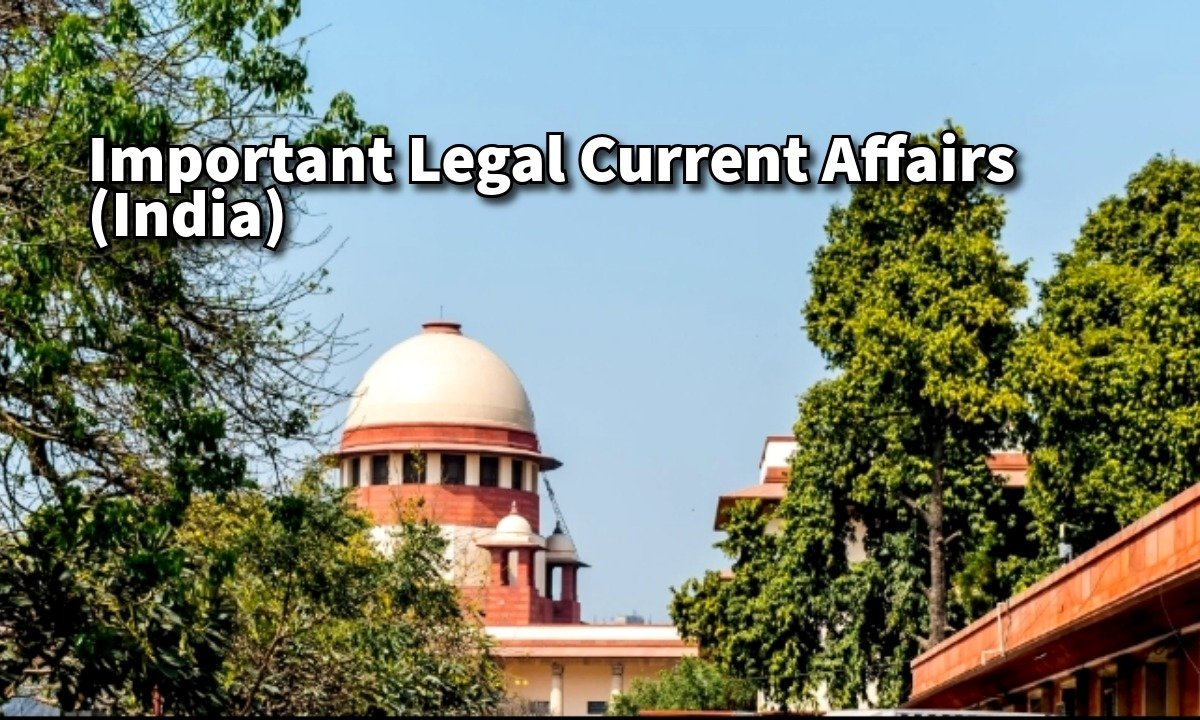
Important Legal Current Affairs (India) – Today’s Key Judicial Updates
Legal developments in India’s courts often shape public policy, personal rights, and social norms. Today’s major rulings from the Supreme Court and High Courts address military pension eligibility, marital disputes, pre-marital relationships, and criminal liability in suicide pacts.
This article explains the latest judgments in simple language for students, aspirants, and general readers.
1. No Pension if Disability or Death is Caused by Smoking

Case: Sarevesh Kumar vs Union of India
Bench: Justices Aravind Kumar & P. B. Varale
Court: Supreme Court of India
Key Ruling
The Supreme Court dismissed a disability compensation claim filed by a former Army personnel. The Court ruled that the disability was linked to his personal habit of smoking approximately ten beedis per day and not attributable to military service.
Legal Basis
The Court referred to:
Regulation 173, Pension Regulations for the Army (1961)
Guide to Medical Officers (2002)
These provisions state that compensation cannot be granted for disability or death resulting from:
Alcohol abuse
Tobacco use
Drug use
Sexually transmitted diseases
because these are considered personal lifestyle choices within the individual’s control.
Why This Matters
This judgment clarifies that service benefits are denied when disabilities arise from personal habits rather than service conditions.
2. Allegations of Extramarital Affair Amount to Mental Cruelty
Case: X vs Y
Court: Karnataka High Court
Key Observation
The Karnataka High Court held that making baseless accusations of an extramarital affair against a spouse amounts to mental cruelty and can justify living separately.
Case Background
The husband sought divorce under Section 13(1)(b) of the Hindu Marriage Act on the ground of desertion.
He alleged that his wife had an extramarital relationship.
However, he failed to provide evidence.
Court Findings
The Court ruled:
Mere accusations without proof cause mental cruelty.
Such accusations provide a valid reason for the wife to live apart.
The husband failed to prove desertion.
Additional Context
The wife had earlier filed a case under Section 498A IPC and the Dowry Prohibition Act, which ended in acquittal.
Both the trial court and High Court dismissed the husband’s divorce plea.
Importance for Law Students & Society
This ruling reinforces that false allegations damaging a spouse’s dignity can themselves constitute cruelty.
3. Supreme Court Advises Caution in Pre-Marital Physical Relationships
Case: Y.K. vs State Govt. of NCT of Delhi
Bench: Justice B. V. Nagarathna & Justice Ujjal Bhuyan
Court: Supreme Court of India
Context
The Supreme Court made oral observations while hearing a bail plea in a case involving alleged rape on a false promise of marriage.
Court’s Observations
Justice Nagarathna remarked that:
Before marriage, individuals are legally strangers.
People should exercise caution before entering physical relationships based solely on promises of marriage.
Trust should be exercised carefully.
Case Facts
The complainant met the accused on a matrimonial website in 2022.
The accused allegedly promised marriage despite being already married.
Physical relations occurred in Delhi and Dubai.
He allegedly recorded intimate videos without consent and threatened to release them.
The complainant later discovered he married another woman in January 2024.
Why This Matters
The case highlights legal risks surrounding consent, false promises of marriage, and digital exploitation.
4. Surviving Partner in Suicide Pact Can Be Guilty of Abetment
Case: Gudipalli Siddhartha Reddy vs State (CBI)
Bench: Justice Rajesh Bindal & Justice Manmohan
Court: Supreme Court of India
Key Judgment
The Supreme Court ruled that a person who survives a mutual suicide pact can be convicted for abetment of suicide.
Legal Reasoning
The Court stated that a mutual agreement to die together creates psychological encouragement (instigation), which can attract liability under:
Section 306 IPC – Abetment of suicide
Section 107 IPC – Abetment defined
Case Background
The Court upheld the conviction of Gudipalli Siddhartha Reddy in connection with the 2002 death of actress Prathyusha.
Legal Significance
This ruling establishes that even mutual agreements can lead to criminal responsibility if one partner survives.
