
Major Buddhist Sites in India: A Journey Through History
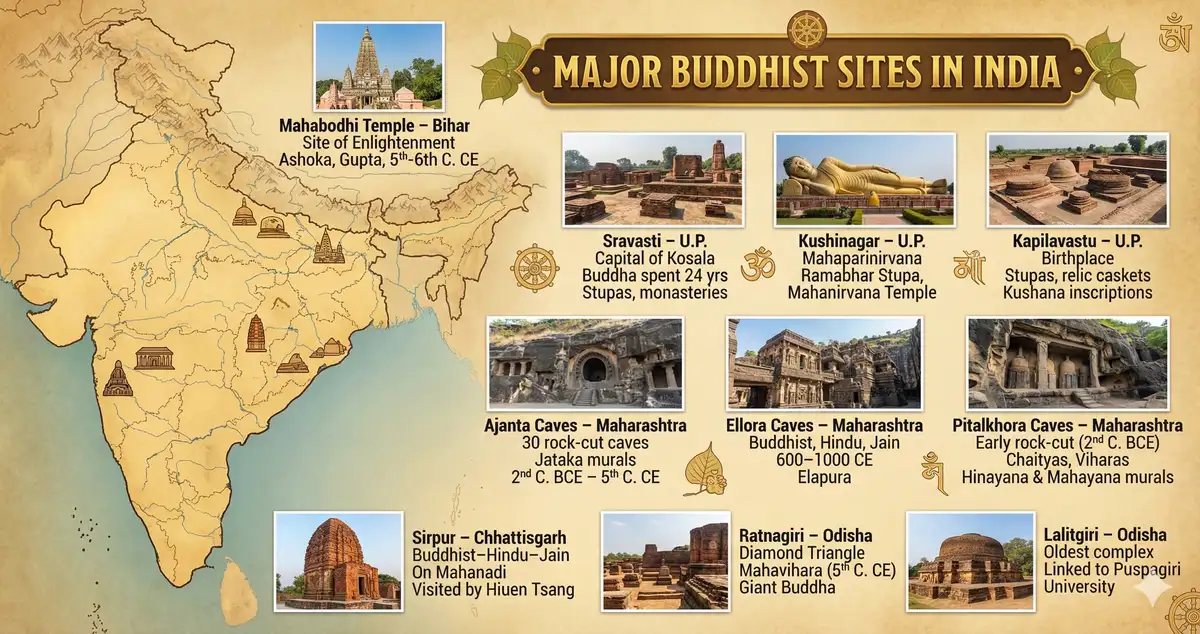
Explore the spiritual and architectural legacy of Buddhism in India. This guide covers ten essential heritage sites—from the Mahabodhi Temple, where Siddhartha Gautama attained enlightenment, to the intricate rock-cut masterpieces of the Ajanta and Ellora Caves. Spanning Bihar, Uttar Pradesh, Maharashtra, Chhattisgarh, and Odisha, these locations highlight the evolution of Buddhist art, from the early Hinayana period to the grand Mahayana monasteries and the intellectual centers of ancient India.
Major Buddhist Sites in India:
Mahabodhi Temple – Bihar
- Site of Buddha’s Enlightenment (Bodhi)
- Built by Ashoka; rebuilt in Gupta period
- Current structure: 5th–6th century CE
Sravasti – Uttar Pradesh
- Capital of Kosala Mahajanapada
- Buddha spent 24 years preaching
- Stupas, monasteries, temples
Kushinagar – Uttar Pradesh
- Site of Mahaparinirvana
- Ramabhar Stupa (cremation site)
- Mahanirvana Temple (reclining Buddha)
Kapilavastu – Uttar Pradesh
- Birthplace of Lord Buddha
- Stupas & relic caskets
- Kushana inscriptions (Kanishka)
Ajanta Caves – Maharashtra
- 30 rock-cut Buddhist caves
- Jataka tales & murals
- 2nd century BCE – 5th century CE
Ellora Caves – Maharashtra
- Buddhist, Hindu & Jain caves
- 600–1000 CE
- Ancient name: Elapura
Pitalkhora Caves – Maharashtra
- Early rock-cut caves (2nd century BCE)
- Chaityas & Viharas
- Hinayana with later Mahayana murals
Sirpur – Chhattisgarh
- Buddhist–Hindu–Jain centre
- On Mahanadi river
- Visited by Hiuen Tsang
Ratnagiri – Odisha
- Part of Diamond Triangle
- Mahavihara (5th century CE)
- Giant Buddha with Padmapani & Vajrapani
Lalitgiri – Odisha
- Oldest Buddhist complex in Odisha
- Linked to Puspagiri University