
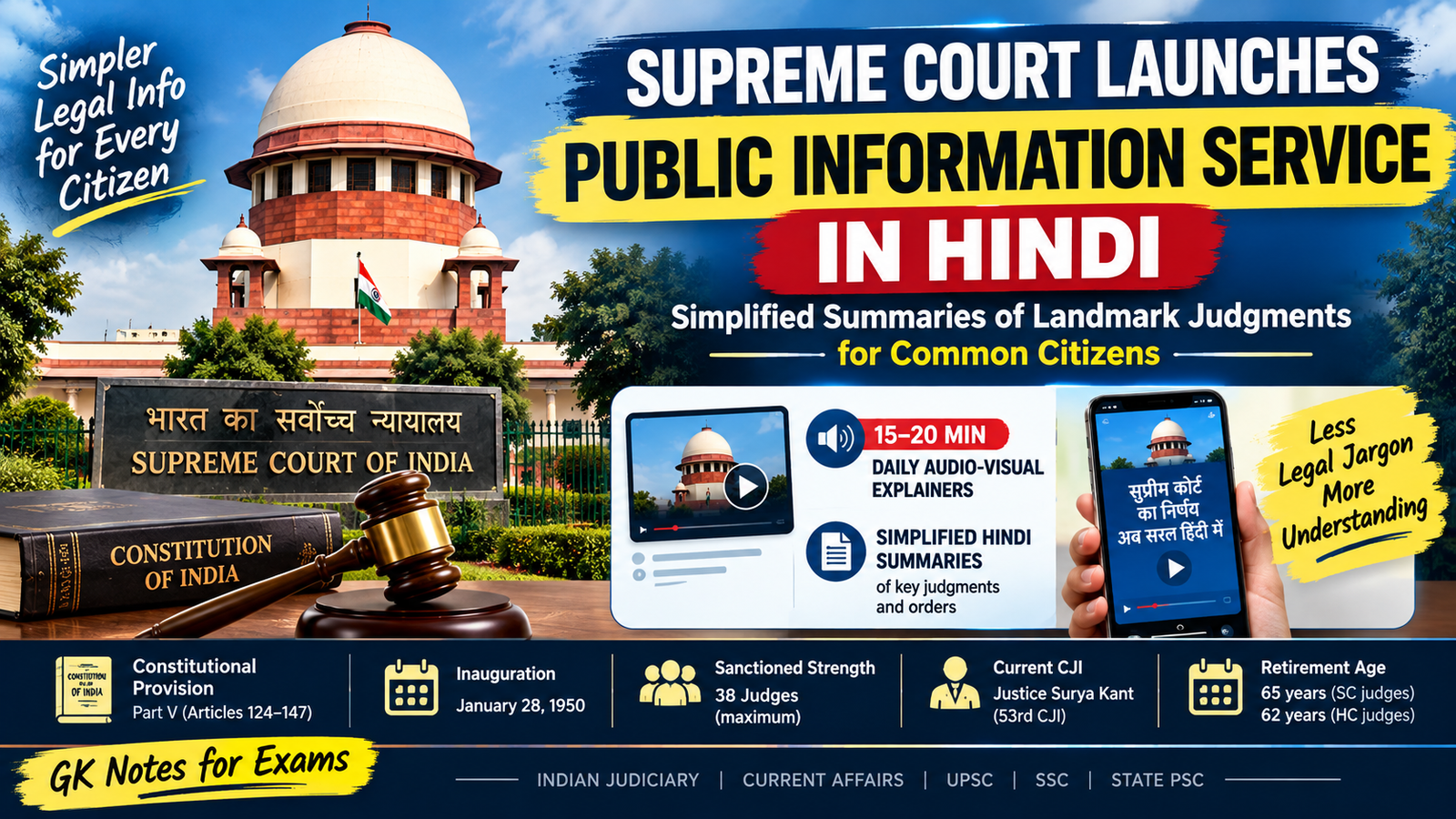
Supreme Court Launches Public Information Service in Hindi: Complete GK Notes
The Supreme Court of India has announced a new Hindi public information service, “Jan Soochna Seva,” to make important judicial information easier for ordinary citizens to understand. The initiative was announced on Hindi Diwas, September 14, 2026, and will provide simplified Hindi summaries of selected important judgments and orders, along with daily Hindi audio-video bulletins of approximately 15–30 minutes.
The initiative is particularly relevant for current affairs, Indian Polity and General Awareness sections of examinations such as UPSC, SSC, State PSC, Banking, Railway and other competitive examinations.
What Is the Supreme Court's Jan Soochna Seva?
Jan Soochna Seva is a new public information initiative of the Supreme Court designed to communicate important judicial decisions in simple Hindi.
Under the service:
- Selected important judgments and orders will have simplified Hindi summaries.
- A daily Hindi audio and video bulletin of approximately 15–30 minutes will explain important judicial developments.
- The relevant official judgment or order will be linked with the summary.
- The service is initially being introduced in Hindi.
- Other Indian languages are planned to be added in phases.
Important Correction for Exams
Some early descriptions refer to the bulletins as 15–20 minutes, but the Supreme Court-related reports published after the September 14 announcement specify approximately 15–30 minutes. Therefore, 15–30 minutes is the safer figure to use in updated exam notes.
Announcement on Hindi Diwas 2026
The Supreme Court announced the initiative on September 14, 2026, coinciding with Hindi Diwas.
The timing connects the initiative with the broader importance of Indian languages in public communication. The Court's stated objective is not simply translation but making judicial information more accessible to people in a language familiar to them.
Why Was the Service Introduced?
Legal judgments can be lengthy and often contain specialised legal terminology. For people who are not lawyers, understanding the practical meaning of a Supreme Court judgment can therefore be difficult.
The new service aims to bridge this communication gap by presenting important judicial information in a simpler and more familiar language.
According to reports on the Court's announcement, the initiative is intended to help:
- Ordinary citizens
- Litigants
- People with disabilities
- People who find lengthy legal documents difficult to read or understand
The objective is to make judicial information more accessible and connect Indian-language communication with access to justice.
Major Features of Jan Soochna Seva
1. Simplified Hindi Judgment Summaries
Selected significant judgments and orders will be accompanied by summaries written in simple Hindi.
This allows readers to understand the broad issue, decision and implications without immediately having to navigate the full legal text.
2. Daily Audio-Video Bulletin
The initiative will also provide a daily Hindi audio and video bulletin of approximately 15–30 minutes covering important judicial decisions and developments.
This multimedia format is particularly useful for people who may find lengthy written judgments difficult to read.
3. Link to the Original Judgment
The simplified summary will be accompanied by a link to the corresponding official judgment or order.
This is an important feature because the summary is intended to improve understanding while the original court document remains the authoritative legal text.
4. Initial Availability in Hindi
The service is being introduced first in Hindi.
The Supreme Court has indicated that work will subsequently be undertaken to extend the service to other Indian languages in a phased manner.
Importance of the Initiative
The Supreme Court's new service addresses an important distinction between availability of information and accessibility of information.
A judgment may already be publicly available, but its legal terminology, length and technical reasoning can make it difficult for a non-lawyer to understand.
By providing simplified summaries and audio-video explanations, the initiative attempts to make important judicial information easier to access.
The service also builds on the Court's broader efforts to make significant judgments more understandable to the public. The Supreme Court has previously maintained a Landmark Judgment Summaries facility for important decisions.
When Was the Supreme Court Established?
The Supreme Court came into existence on January 26, 1950, when the Constitution of India came into force.
However, its formal inauguration took place on January 28, 1950, at the Chamber of Princes in the old Parliament House.
Exam Tip: Do not confuse these two dates.
- January 26, 1950 → Supreme Court came into existence
- January 28, 1950 → Supreme Court was inaugurated
Supreme Court Judge Strength: Important 2026 Update
The sanctioned strength of the Supreme Court was increased in 2026.
In May 2026, the President promulgated the Supreme Court (Number of Judges) Amendment Ordinance, 2026, increasing the number of judges other than the Chief Justice from 33 to 37. This raised the total sanctioned strength, including the CJI, from 34 to 38 judges.
The change was subsequently enacted through the Supreme Court (Number of Judges) Amendment Act, 2026, which received presidential assent in August 2026.
Therefore:
Current maximum sanctioned strength in 2026 → 38 judges, including the Chief Justice of India.
This is an important update because older GK books and websites may still mention 34 judges. The Supreme Court's own historical page still describes the earlier 34-judge structure, so exam aspirants should use the 2026 amendment when answering questions about the current sanctioned strength.
Who Is the Current Chief Justice of India?
As of September 2026, Justice Surya Kant is the Chief Justice of India.
He took oath as the 53rd Chief Justice of India on November 24, 2025. The official Supreme Court website lists him as the serving CJI and gives his retirement date as February 9, 2027.
Quick Facts
- Name: Justice Surya Kant
- Position: Chief Justice of India
- CJI Number: 53rd
- Assumed office: November 24, 2025
- Retirement: February 9, 2027
Retirement Age of Supreme Court Judges
A Supreme Court judge retires at the age of 65 years.
For comparison, a High Court judge retires at 62 years. The Supreme Court's official constitutional information confirms the retirement age of its judges as 65, while its jurisdiction information states that High Court judges hold office until 62.
Remember
Supreme Court Judge → 65 years
High Court Judge → 62 years
Supreme Court and Access to Justice
The new Hindi public information service is part of a broader idea of making justice more accessible.
Access to justice does not only involve the ability to approach a court. Understanding the outcome of a judicial proceeding is also important for citizens and litigants.
The Hindi service combines:
Simple language + Written summaries + Audio + Video + Links to original judgments
This approach can help bridge the gap between complex judicial documents and public understanding.
The Court has also indicated that the service will eventually expand beyond Hindi to other Indian languages, allowing citizens from different linguistic regions to receive concise information about significant Supreme Court decisions in their own languages.
