
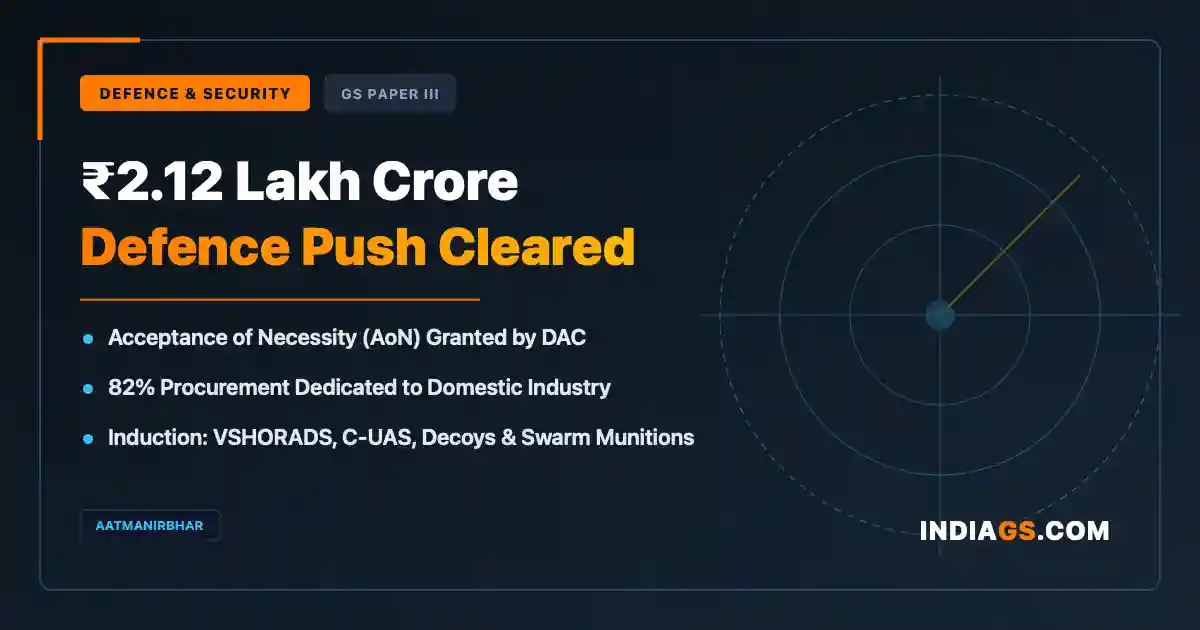
Context The Defence Acquisition Council (DAC), the apex body for military capital acquisitions chaired by Union Defence Minister Rajnath Singh, accorded Acceptance of Necessity (AoN) for tri-service procurement proposals estimated at ₹2.12 lakh crore. In alignment with the domestic manufacturing roadmap under Aatmanirbhar Bharat, approximately 82% of the total acquisition budget is mandated to be sourced from the indigenous defence industrial base.
Breakdown of Platform Allocations
- Indian Army Capabilities:
- Air Defence & Counter-Drone Warfare: Induction of Very Short-Range Air Defence Systems (VSHORADS) to neutralise low-altitude aerial threats, paired with vehicle-mounted Counter-Unmanned Aerial Systems (C-UAS) designed to shield armored columns from loitering munitions.
- Firepower & Mobility: Self-propelled tracked artillery gun systems to support strike corps across desert and semi-desert sectors, accompanied by High Mobility Vehicles (HMVs) for high-altitude logistical endurance.
- Tactical Awareness: Gunshot Response Systems (GSRSs) for situational awareness and real-time counter-sniper tracking, alongside long-range kamikaze drones and tactical surveillance UAVs.
- Indian Navy Fleet Survivability:
- Active Offboard Decoy Systems (AODS): Electronic warfare countermeasures designed to divert incoming radar-guided, supersonic anti-ship missiles away from primary naval hulls.
- Next-Generation Surface Combatants: Administrative approval for indigenous ship design and modular construction frameworks.
- Indian Air Force Additions:
- Tactical Aviation: Utility helicopters to handle forward troop and cargo transit.
- High-Altitude Radar Networks: Transportable X-band Doppler weather radar installations providing localised meteorological intelligence across dynamic frontier terrains.
Strategic Assessment for UPSC Aspirants
- Transition from Platform-Centric to Sensor-Centric Warfare: The conflict dynamics in Ukraine and West Asia have shown that legacy armour without integrated active protection systems (APS) and soft-kill counter-drone decoys is vulnerable. Cleared systems like VSHORADS and C-UAS address asymmetric frontline aerial threats.
- Shift from 'Make in India' to 'Aatmanirbharta 2.0': Setting an 82% domestic sourcing mandate under the Defence Acquisition Procedure (DAP) provides predictable revenue visibility for domestic Tier-1 defence prime contractors, MSMEs, and private-sector R&D ventures.
- Capital Budgeting Dynamics: Granting an AoN initiates formal procurement—clearing the path for Requests for Proposals (RFPs), technical benchmark validations, field evaluation trials, and commercial price contract signing under the Capital Budget head.
